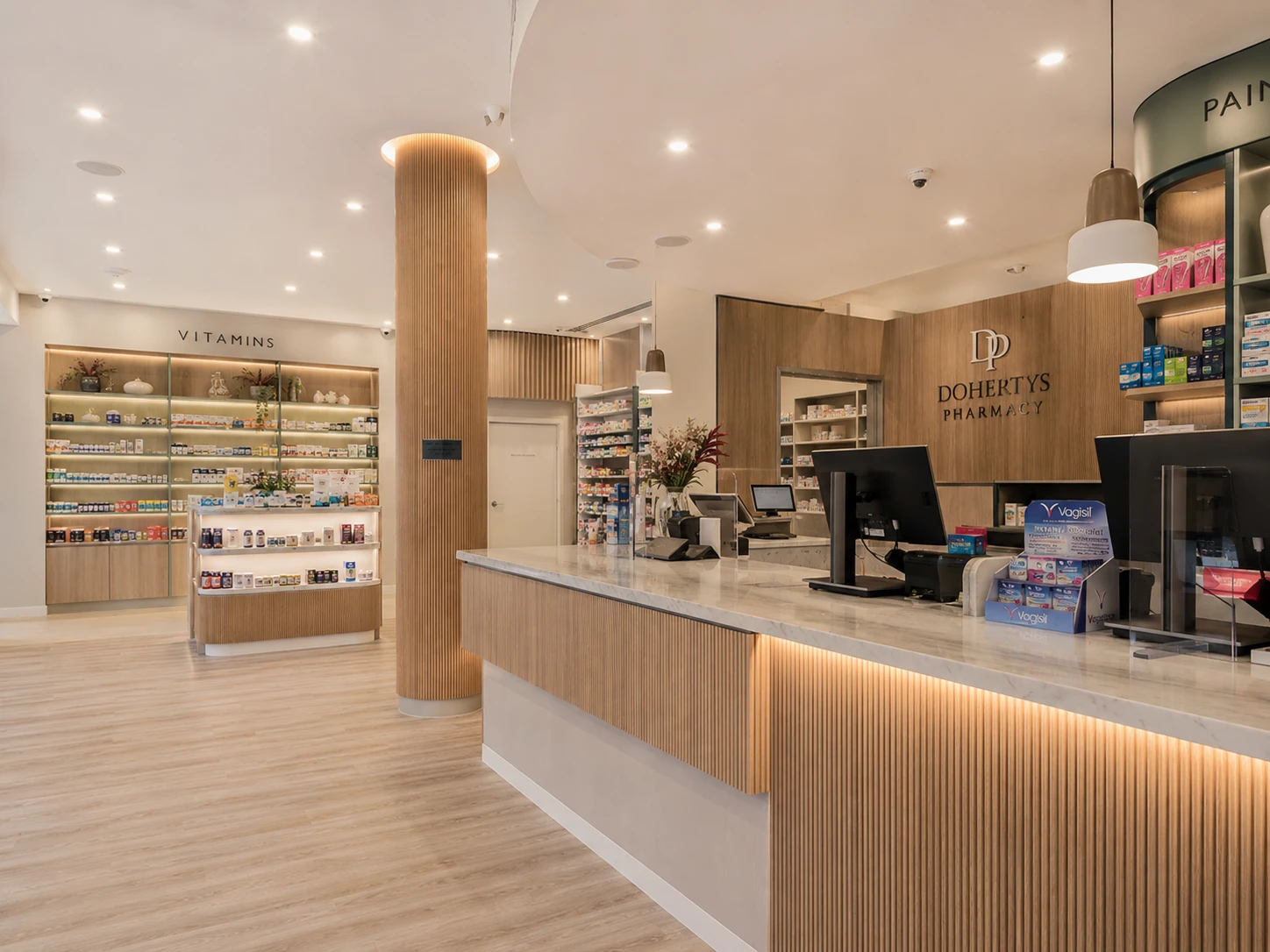
Pharmacy Fitout Cost Sydney 2026: $80K–$600K+ Guide
A pharmacy fitout in Sydney occupies a category of its own within commercial construction. It combines a strictly regulated dispensary environment with a consumer-facing retail space, and the design must serve both functions simultaneously. The dispensary team needs a layout that supports accuracy, efficiency, and full compliance with the legal requirements governing how controlled substances are stored and dispensed. The retail customer needs a space that feels professional, calm, and easy to navigate.
Getting the balance right requires a builder who understands both sides of the brief. Getting the compliance wrong, on either side, has consequences that go well beyond construction cost.
Building Project Solutions has delivered medical and healthcare fitouts across Sydney for 35 years. This guide covers what actually drives pharmacy fitout costs in Sydney in 2026, what broad indicative ranges look like across different pharmacy types, and why the only number that matters is the one produced after an experienced specialist has walked your specific site.
Read how Building Project Solutions handles variations and pricing transparency before you commit to anything.
Why a Pharmacy Fitout Is Different From Every Other Retail or Medical Fitout
A pharmacy is not a retail store that sells medicine. It is a licensed premises operating under the regulatory framework of the Pharmacy Board of Australia, the NSW Pharmacy Council, the Therapeutic Goods Administration, and the relevant NSW legislation governing controlled substances.
Every one of these regulatory bodies has a view on how the physical environment of a pharmacy needs to be designed and built. And unlike most commercial compliance obligations, the pharmacy-specific requirements need to be submitted to and approved by the NSW Pharmacy Council before construction begins. This is separate from and in addition to any DA or CDC approval required under the planning framework.
The physical separation of the dispensary from the retail floor is mandatory. Access to the dispensary must be controlled and limited to authorised staff. The configuration of this separation and the specific requirements around it must be confirmed with the pharmacist-in-charge and the NSW Pharmacy Council before design is finalised.
This is not a standard commercial fitout with a few extra shelves. It is a regulated built environment that requires specialist knowledge to design, document, and construct correctly.
The Variables That Drive Pharmacy Fitout Costs in Sydney
Dispensary Design and Workflow
The dispensary is where pharmacy fitout costs diverge most sharply from standard retail or medical fitout costs. Every element of the dispensary must be designed around workflow, compliance, and controlled substance security simultaneously.
Key dispensary design cost drivers include:
Dispensing bench configuration: the layout of the dispensing bench must support the workflow of the dispensary team while maintaining clear sightlines for supervision and physical separation from the retail area. Custom joinery built to the specific workflow requirements of the practice is the standard approach. Off-the-shelf solutions rarely meet the operational requirements of a contemporary dispensary.
Dispensary cabinetry and storage: the volume and type of stock carried determines the storage system required. Drawer-based dispensing systems, fast-mover locations, and integrated returns management all affect the joinery specification and cost.
Refrigeration: pharmacy-grade refrigeration for temperature-sensitive medicines is required in every dispensary. The specification, monitoring capability, and alarm systems required go beyond standard commercial refrigeration.
Point of dispensing technology integration: automated dispensing systems, script management software, and barcode scanning infrastructure all need to be coordinated with the joinery design before manufacture begins. Changes after manufacture are expensive.
Schedule 8 Controlled Substance Storage
Every pharmacy in NSW that dispenses Schedule 8 controlled substances requires a secure storage facility that meets the specific requirements of NSW legislation and the Pharmacy Board of Australia guidelines.
Schedule 8 storage in a pharmacy fitout must be:
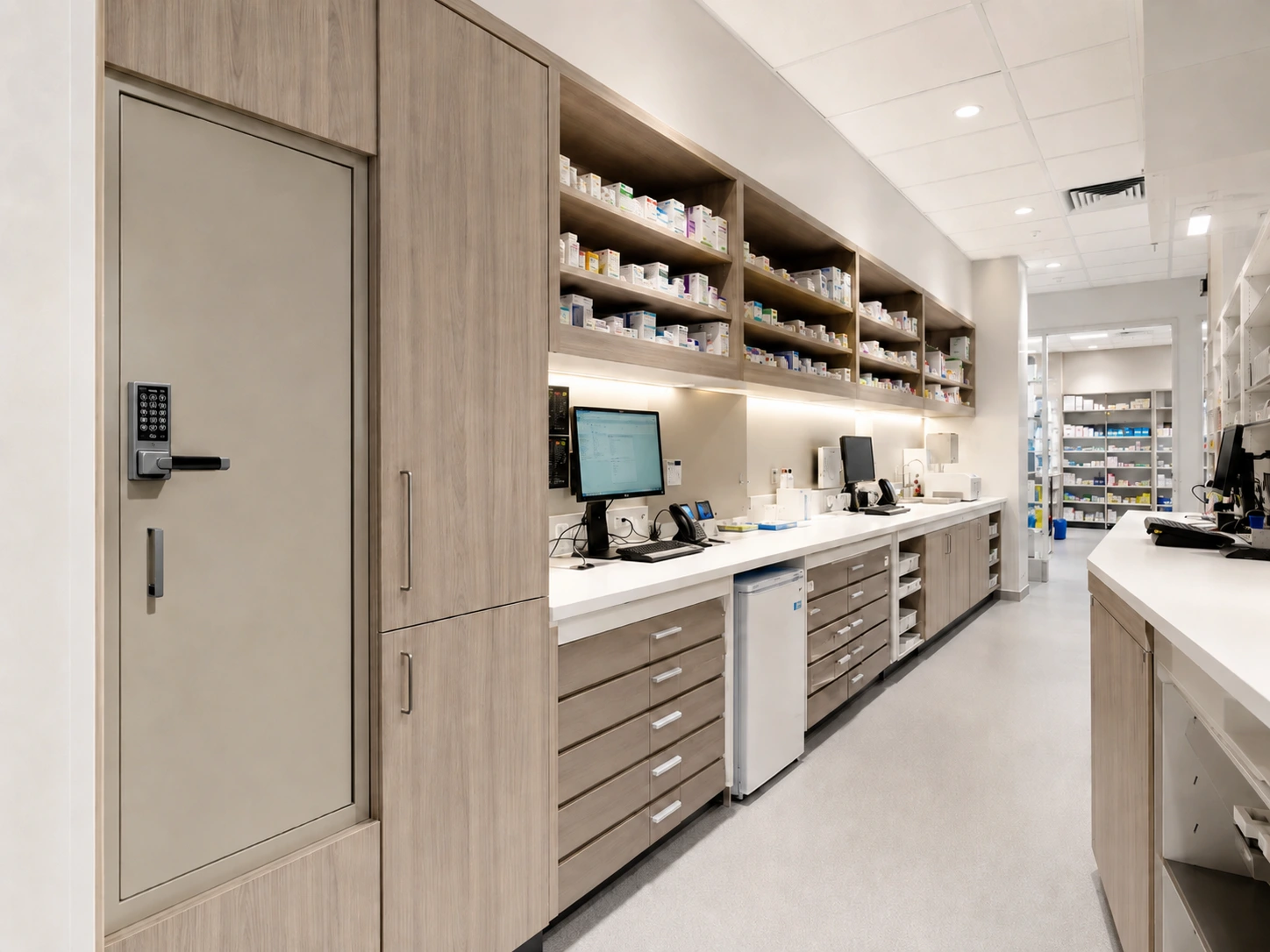
A separate locked storage unit securely attached to the structure of the building, either bolted to the wall or the floor. A free-standing safe does not meet the requirements. The safe must meet the specified security rating required under NSW legislation. The safe must be located within the dispensary area, not accessible to the public or unauthorised staff.
Getting the Schedule 8 storage specification wrong is one of the most common compliance failures in pharmacy fitouts. It is discovered during the NSW Pharmacy Council inspection before the pharmacy can open. Retrofitting a compliant safe after the fitout is complete typically requires structural work to the wall or floor and is significantly more expensive than specifying it correctly in the first place.
Private Consultation Area
A private consultation area is a mandatory requirement under the Pharmacy Board of Australia standards. The consultation area must provide genuine privacy for patient consultations. It cannot be a curtained-off section of the dispensary or a corner of the retail floor.
The consultation area requirement adds a dedicated room or enclosed space to the fitout scope that does not exist in a standard retail fitout. In smaller tenancies this can be one of the most challenging design constraints to satisfy without compromising the retail floor area or the dispensary workflow.
The acoustic specification of the consultation area matters. The privacy obligation extends to acoustic privacy: conversations between pharmacist and patient must not be audible in the retail area or dispensary.
Retail Front of House
The retail section of a pharmacy operates under different design principles from the dispensary but carries its own compliance obligations under TGA advertising regulations, DDA access requirements, and the general retail fitout standards that apply to any commercial tenancy.
Key retail cost drivers in a pharmacy fitout include:
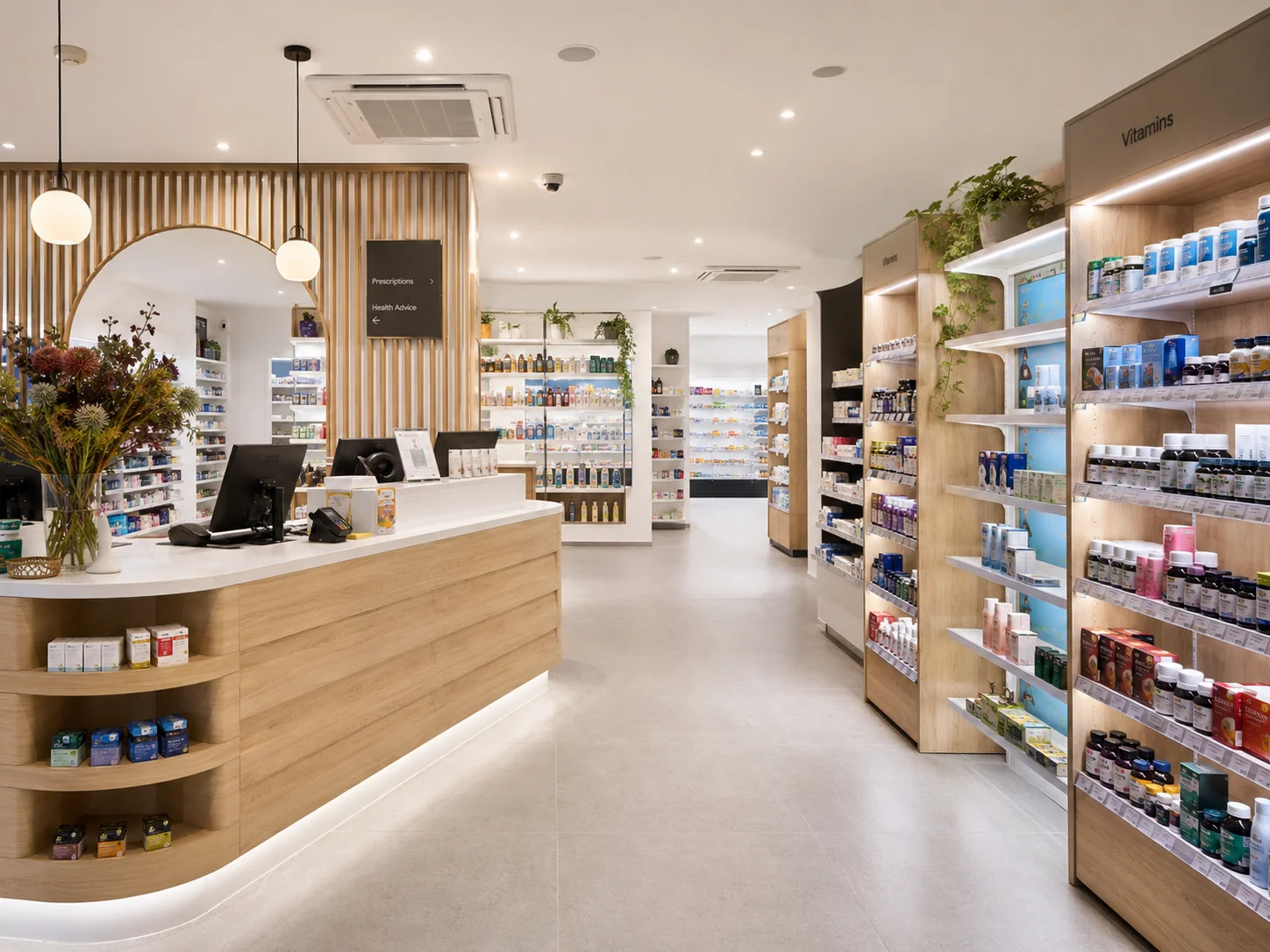
Gondola shelving systems: commercial pharmacy gondola shelving is specialist equipment. The configuration, height, aisle width, and accessibility requirements are all specific to pharmacy retail environments.
OTC display and product placement: over-the-counter product displays, seasonal promotion areas, and behind-counter restricted product displays all require joinery and fixturing designed around the specific product mix and workflow of the pharmacy.
Point of sale infrastructure: pharmacy POS systems integrate with dispensing software, PBS claiming systems, and inventory management. The POS infrastructure needs to be coordinated with the retail design and the dispensary workflow from the start.
DDA access compliance: all areas of the pharmacy accessible to customers must meet DDA access requirements including accessible counter heights, accessible pathways throughout, and accessible consultation facilities.
NSW Pharmacy Council Approval
In NSW every new pharmacy fitout requires submission of detailed drawings to the NSW Pharmacy Council for approval before construction begins. This is a separate process from any building approval and must be completed before a DA or CDC application is lodged or simultaneously with it depending on the timeline.
The NSW Pharmacy Council assesses the submitted drawings against the Pharmacy Board of Australia standards covering dispensary layout, controlled substance storage, consultation privacy, and staff supervision. The Council may request amendments to the design before granting approval.
Engaging a builder and a designer who understand what the NSW Pharmacy Council looks for in a submitted fitout package is the most reliable way to avoid lengthy back-and-forth with the Council that extends the pre-construction phase and delays your opening.
Compounding Pharmacy Additional Requirements
Pharmacies that offer compounding services (preparing customised medications for individual patients) operate under additional TGA and Pharmacy Board requirements that significantly affect the fitout scope and cost.
The Pharmacy Board compounding guidelines that took effect in October 2024 require a documented facility risk assessment before commencing any compounding. The physical environment requirements depend on the GMP grade assigned to each area of the compounding facility.
For non-sterile compounding the requirements include dedicated compounding areas with appropriate surfaces, ventilation, and contamination controls. For sterile compounding the requirements extend to cleanroom construction with HEPA filtration, controlled pressure differentials, and ISO air classification.
The HVAC system alone for a compounding cleanroom currently costs $25,000 to $70,000 depending on the ISO air classification required. Cleanroom construction, specialist equipment, water purification, environmental monitoring, and TGA validation are all additional costs above the standard pharmacy fitout budget.
If your pharmacy will offer compounding services the fitout brief must reflect this from the start. Compounding requirements cannot be retrofitted into a standard pharmacy fitout without significant demolition and reconstruction.
DA or CDC Approval
Most Sydney pharmacy fitouts require either a Development Application or a Complying Development Certificate depending on the specific works and whether there is a change of use involved.
A CDC may apply where the tenancy is already approved for pharmacy or medical use and no structural changes are involved. A DA is typically required where there is a change of use from retail or another commercial classification to pharmacy use, or where structural changes are involved.
Construction costs in Australia are currently rising at 4 to 6 percent per year. Copper, which drives the cost of all electrical, plumbing, and mechanical services, increased by more than 16 percent over the past year. A pharmacy fitout priced today is pricing into a different market from the same project priced in six months. Acting earlier rather than later has a clearer financial case in 2026 than it has had at any point in recent years.
Broad Indicative Cost Ranges for Sydney Pharmacy Fitouts in 2026
The following ranges cover construction, compliance, joinery, services, and project management. They do not include pharmacy equipment, dispensing technology, gondola shelving systems, or fitout contributions from landlords or pharmacy groups.
Basic Pharmacy Fitout
A small pharmacy tenancy with standard dispensary joinery, compliant Schedule 8 storage, basic consultation area, standard retail gondola configuration, and a straightforward approvals pathway.
Broad indicative range: under $1,000 per sqm
Broad indicative total for a 100sqm tenancy: $80,000 to $150,000
What moves this number higher: complex dispensary workflow requirements, consultation room acoustic specification, DDA access upgrades, change of use DA, premium retail finishes.
Standard Pharmacy Fitout
A mid-size pharmacy with a well-configured dispensary, compliant controlled substance storage, a proper private consultation room, quality retail fitout, and full compliance documentation for the NSW Pharmacy Council.
Broad indicative range: $1,500 to $2,500 per sqm
Broad indicative total for a 150sqm tenancy: $225,000 to $375,000
What moves this number higher: automated dispensing system integration, compounding area, premium retail finishes, heritage building constraints, complex DA requirements.
Premium or Compounding Pharmacy Fitout
A full-service pharmacy with a premium retail environment, comprehensive dispensary fitout, private consultation facilities, and compounding capability where required.
Broad indicative range: $2,500 to $4,000 per sqm and above
Compounding pharmacy HVAC systems alone currently cost $25,000 to $70,000 depending on the ISO air classification required before any other compounding infrastructure is added.
Disclaimer: Every cost figure in this guide is a broad indicative range only. It is not a quote, not an estimate, and not a representation of what your fitout will cost. Pharmacy fitout costs in Sydney are determined by your specific pharmacy type, your tenancy, the compliance obligations that apply under the NSW Pharmacy Council and Pharmacy Board of Australia standards, the scope of your dispensary and retail requirements, the cost of materials and labour at the time your project is priced, market conditions, supply chain, and the level of finish and detail you require. A standard community pharmacy and a compounding pharmacy on the same floor plan can produce vastly different construction costs. Nothing in this guide should be relied upon for budgeting, financial planning, lending, or business case purposes. The only way to get a reliable cost assessment for your specific project is to engage an experienced pharmacy fitout specialist who has physically inspected your site and understands the full NSW Pharmacy Council and Pharmacy Board compliance framework.
Why the NSW Pharmacy Council Submission Must Happen Before Construction Starts
The NSW Pharmacy Council approval process is not a formality. The Council assesses the submitted drawings in detail and will request amendments if the design does not meet the required standards. An amended design may require significant changes to the construction scope, the joinery specification, or the spatial layout of the dispensary.
Discovering these amendments after construction has started is one of the most expensive problems in a pharmacy fitout. Changes to joinery after manufacture, structural changes to room layouts, and retrofitting compliant controlled substance storage are all significantly more expensive than getting the design right before construction begins.
The most efficient approach is to engage a builder and designer who understand what the NSW Pharmacy Council requires before the design is developed. This means the drawings submitted to the Council reflect the compliance requirements from the start rather than requiring multiple rounds of amendment.
Planning a pharmacy fitout in Sydney? Building Project Solutions has delivered medical and healthcare fitouts across Sydney for 35 years. Book a strategy session with Stephen before you commit to a site or a design.
How to Protect Your Budget on a Sydney Pharmacy Fitout
Submit drawings to the NSW Pharmacy Council before construction starts. The Council approval process must be completed before construction begins. Engaging a builder who understands what the Council requires means the drawings are right the first time rather than requiring multiple amendments.
Specify Schedule 8 storage correctly before joinery goes to manufacture. The compliant safe must be specified, procured, and coordinated with the joinery design before manufacture begins. The structural attachment requirements must be confirmed with the builder before framing is complete. Retrofitting a compliant safe after the fitout is complete is significantly more expensive.
Decide on compounding scope before design starts. If your pharmacy will offer compounding services the fitout brief must reflect this from the start. Compounding requirements cannot be retrofitted into a standard pharmacy fitout without significant cost and disruption.
Map the DA or CDC pathway before you sign the lease. A change of use from retail to pharmacy use typically requires a DA. Understanding the approvals pathway and timeline before you commit to a lease protects your opening date and your budget.
Lock joinery specification before manufacture. The dispensary bench configuration, storage system, refrigeration specification, and technology integration all need to be locked in writing before manufacture begins. Changes after manufacture are expensive variations that extend the programme.
Speak with someone who has delivered healthcare fitouts many times. The intersection of building compliance, Pharmacy Council requirements, and Pharmacy Board standards requires a builder with genuine healthcare fitout experience. Stephen Spagnol has delivered medical and healthcare fitouts across Sydney for 35 years. Contact BPS today to discuss your project before you commit to anything.
Get a real assessment for your pharmacy project. Stephen Spagnol has 35 years of Sydney fitout experience including medical, dental, and healthcare environments. Contact BPS today for an honest conversation about your project before you commit to anything. No obligation. No pressure. Just clarity.
Frequently Asked Questions
How much does a pharmacy fitout cost in Sydney?
As a broad indicative guide only, pharmacy fitout costs in Sydney in 2026 range from approximately $80,000 to $150,000 for a basic small pharmacy through to $600,000 or more for a large premium or compounding pharmacy. Standard pharmacy fitouts typically range from $1,500 to $2,500 per square metre for construction and compliance. These figures do not include pharmacy equipment, dispensing technology, or gondola shelving. Every project is different and costs vary significantly depending on dispensary complexity, compounding requirements, compliance obligations, and market conditions at the time your project is priced. These figures are not quotes or estimates and should not be used for budgeting without a site inspection from an experienced specialist.
What compliance requirements apply to a pharmacy fitout in NSW?
A pharmacy fitout in NSW must satisfy the Pharmacy Board of Australia standards, the NSW Pharmacy Council requirements, and the relevant NSW legislation governing controlled substances. Key physical requirements include mandatory physical separation of the dispensary from the retail floor, compliant Schedule 8 controlled substance storage securely attached to the building structure, a private consultation area with acoustic privacy, and staff supervision sightlines throughout the dispensary. Detailed drawings must be submitted to and approved by the NSW Pharmacy Council before construction begins. This is separate from any DA or CDC approval required under the planning framework.
How long does a pharmacy fitout take in Sydney?
As a general guide, a standard community pharmacy fitout in Sydney takes 6 to 12 weeks from construction start to opening depending on scope and complexity. This does not include the NSW Pharmacy Council drawing submission and approval process which should be initiated before construction starts, or the DA or CDC approval phase where required. Compounding pharmacy fitouts with cleanroom requirements take longer due to the specialist construction and validation requirements. Every project runs to its own programme.
Do I need DA or CDC approval for a pharmacy fitout in Sydney?
Most Sydney pharmacy fitouts require either a DA or a CDC depending on the specific works and whether there is a change of use involved. A CDC may apply where the tenancy is already approved for pharmacy or medical use and no structural changes are involved. A DA is typically required where there is a change of use from retail or another commercial classification to pharmacy use. The NSW Pharmacy Council drawing submission is a separate process that must also be completed before construction begins. Map both approval pathways before you commit to a tenancy.
What is the most expensive part of a pharmacy fitout?
The dispensary joinery and controlled substance storage is typically the highest-cost single element in a standard pharmacy fitout. For compounding pharmacies the HVAC and cleanroom construction becomes the dominant cost driver, with HVAC systems alone currently costing $25,000 to $70,000 depending on the ISO air classification required. Schedule 8 storage that is not specified correctly before construction starts is one of the most common and most expensive compliance failures in pharmacy fitouts. Retrofitting a compliant safe after construction is complete requires structural work and is significantly more costly than getting it right at design stage.
Ready to discuss your project?
Our team has 35 years of experience delivering Medical Fitouts across Sydney.
Get in Touch