Commercial Kitchen Fitout Cost Sydney 2026: $50K–$750K+ Guide
A commercial kitchen fitout in Sydney is one of the most technically demanding and compliance-intensive construction projects in the hospitality sector. It is not a domestic kitchen renovation with stainless steel benches. It is a regulated food premises that must satisfy AS4674-2004, AS 1668.2, AS/NZS 3500.2, the Food Act 2003, and local council food premises registration requirements before a single meal can be prepared.
Building Project Solutions has delivered hospitality fitouts across Sydney for 35 years including commercial kitchens for restaurants, cafes, bars, hotels, and catering operations. This guide covers what actually drives commercial kitchen fitout costs in Sydney in 2026, what broad indicative ranges look like across different kitchen types, and why the only number that matters is the one produced after an experienced specialist has walked your specific site.
Read how Building Project Solutions handles variations and pricing transparency before you commit to anything.
Why a Commercial Kitchen Fitout Is the Most Complex Element of Any Hospitality Project
Every hospitality venue that prepares food needs a commercial kitchen. The kitchen is also consistently the most expensive element of any hospitality fitout and the one most likely to cause budget overruns when it is not properly scoped before construction starts.
The complexity comes from the intersection of four separate compliance frameworks that all apply simultaneously. AS4674-2004 governs the design, construction, and fitout of food premises. AS 1668.2 governs the mechanical ventilation and exhaust systems. AS/NZS 3500.2 governs the grease trap and trade waste plumbing. AS 1851 governs the fire safety systems including the wet chemical suppression system above cooking equipment. All four must be satisfied before the local council will register the premises as a food business under the Food Act 2003.
Getting any one of these wrong does not just add cost. It can prevent the premises from opening at all.
The Variables That Drive Commercial Kitchen Fitout Costs in Sydney
Kitchen Size and Type
The type of commercial kitchen being built is the primary driver of fitout cost. A small cafe kitchen with an espresso machine, a sandwich press, and a compact prep bench has a fundamentally different cost profile from a full production kitchen serving 200 covers per service.
Key kitchen types and their cost profiles:
A basic espresso bar or minimal food preparation kitchen requires limited trade waste plumbing, a compact exhaust system, and basic stainless steel preparation surfaces. This is the lowest cost commercial kitchen category.
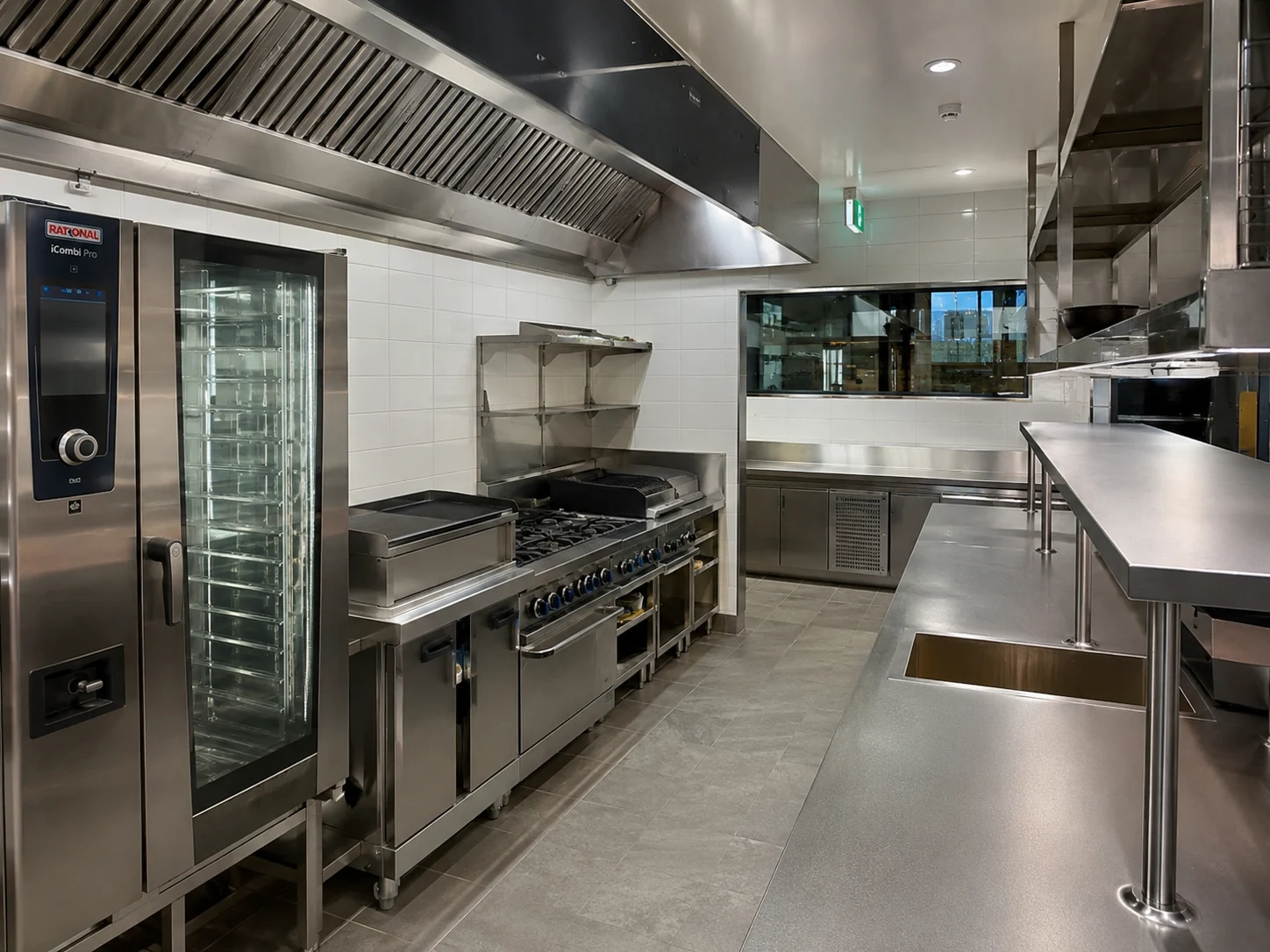
A standard cafe or restaurant kitchen with cooking equipment including combi ovens, grills, and fryers requires a full exhaust canopy system, grease trap installation, wet chemical fire suppression, and commercial-grade floor drains and surfaces throughout.
A high-volume restaurant or hotel kitchen adds cool rooms, a pass window with heat lamps, a dishwasher room with commercial dishwasher drainage, a dry store, and potentially a preparation kitchen separate from the main cooking line.
A commissary or production kitchen serving multiple venues or a catering operation requires the most extensive trade waste infrastructure, the largest exhaust systems, and the most rigorous compliance documentation of any kitchen type.
Equipment typically represents 40 to 60 percent of the total commercial kitchen project budget. This guide focuses on the construction and fitout side. Equipment is procured separately by specialist commercial kitchen equipment suppliers.
The Exhaust Canopy and Ventilation System
The exhaust canopy and mechanical ventilation system is consistently the most underestimated cost in a commercial kitchen fitout. It is also one of the most consequential compliance items. An exhaust system that does not meet AS 1668.2 is a food premises compliance failure that can result in council refusing to register the premises.
Key exhaust system cost drivers:
The size and specification of the exhaust canopy is determined by the cooking equipment beneath it, the heat load generated, and the ductwork routing to the building exterior. A canopy that is undersized for the cooking equipment beneath it does not meet AS 1668.2 requirements.
The ductwork routing from the canopy to the building exterior is one of the most significant variables in the exhaust system cost. A kitchen on the ground floor of a single-storey building with easy roof access has a very different ductwork cost from a kitchen in a multi-level building where the ductwork must travel through multiple floors and fire-rated penetrations.
Make-up air supply must be coordinated with the exhaust system to maintain appropriate air balance. An exhaust system without adequate make-up air creates negative pressure in the kitchen that affects cooking performance, staff comfort, and compliance.
The exhaust system must comply with AS 1851 for ongoing maintenance. Every commercial kitchen in NSW must submit an Annual Fire Safety Statement certifying that all fire protection systems including the exhaust system have been maintained in accordance with the standard. The grease accumulation in ductwork is a significant fire risk: AS 1851 Section 14.2.3 sets a maximum residue threshold of 50 microns after cleaning. This maintenance obligation starts from day one of operation and must be built into the operational budget.
Grease Trap Installation
Every commercial kitchen drain in NSW requires a grease trap under AS/NZS 3500.2. The grease trap intercepts fats, oils, and grease from kitchen wastewater before it enters the sewer system. Discharging untreated trade waste to sewer without an approved grease trap is a serious regulatory breach in NSW with significant penalties.
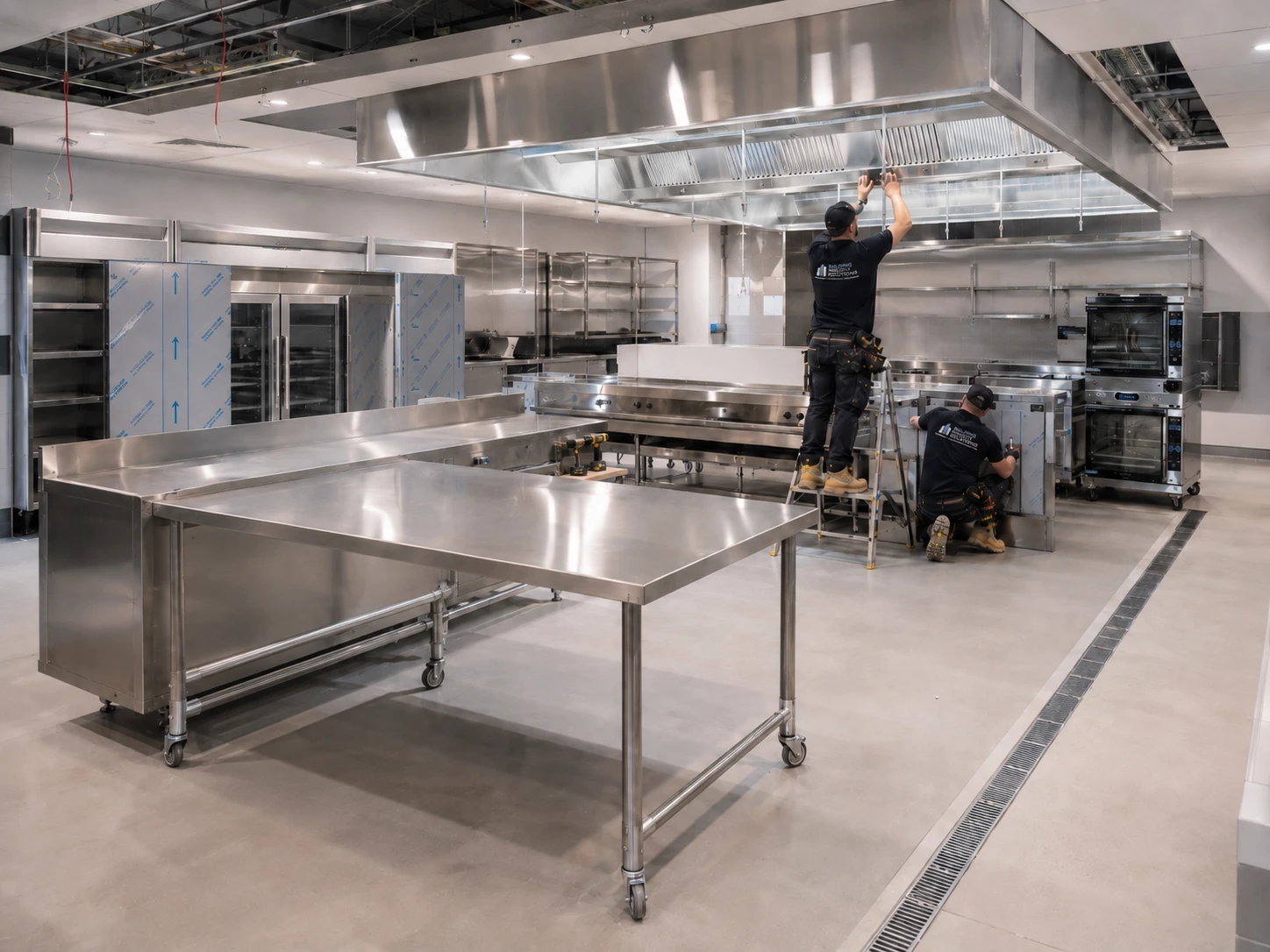
In-ground grease traps installed externally are the most common configuration in Sydney commercial kitchens. When installed externally the grease trap is invisible inside the kitchen. The kitchen floor has standard continuous commercial tiling with floor waste drains under sinks, combi ovens, and prep areas. Wastewater flows through these drains and travels through the floor pipes horizontally out of the building to the buried external tank.
AS 4674 specifically discourages having grease trap access points inside active food preparation areas because lifting a grease trap lid releases toxic sewer gases and bacteria that create an immediate food contamination hazard. In practice this means the kitchen floor should be clean and continuous with no access lids or manholes visible.
The grease trap size is determined by the fixture unit count, the flow rates of the connected equipment, and the volume of cooking activity. A grease trap that is undersized for the kitchen it serves will require more frequent pump-out and is more likely to fail, causing wastewater backing up into the kitchen floor drains.
Key grease trap cost variables:
The location of the external tank relative to the building affects the cost of the connecting pipework. A tank close to the building exterior costs less to connect than one that requires long horizontal pipe runs or pipe routing under existing structures.
The depth of the connecting pipework affects the excavation and installation cost. Deep connections through existing concrete slabs or under established landscaping add significant cost.
Sydney Water trade waste approval is required for all commercial kitchens discharging to the sewer. The approval application must include the grease trap specification and must be obtained before the kitchen can operate.
Wet Chemical Fire Suppression System
A wet chemical fire suppression system is required above all commercial cooking equipment in Sydney. The system is specifically designed to suppress grease fires which have a fundamentally different combustion profile from fires that standard sprinkler systems are designed to address.
The wet chemical suppression system must be installed and certified before the premises can open. It must be serviced every six months by a certified technician and the service records must be available for inspection. The annual fire safety statement certification includes the suppression system.
The cost of the suppression system depends on the number of cooking appliances, the size of the canopy, and the nozzle configuration required. A kitchen with multiple fryers and a solid fuel cooking appliance has a more complex suppression system than one with standard gas cooking equipment.
Stainless Steel Benching and Surfaces
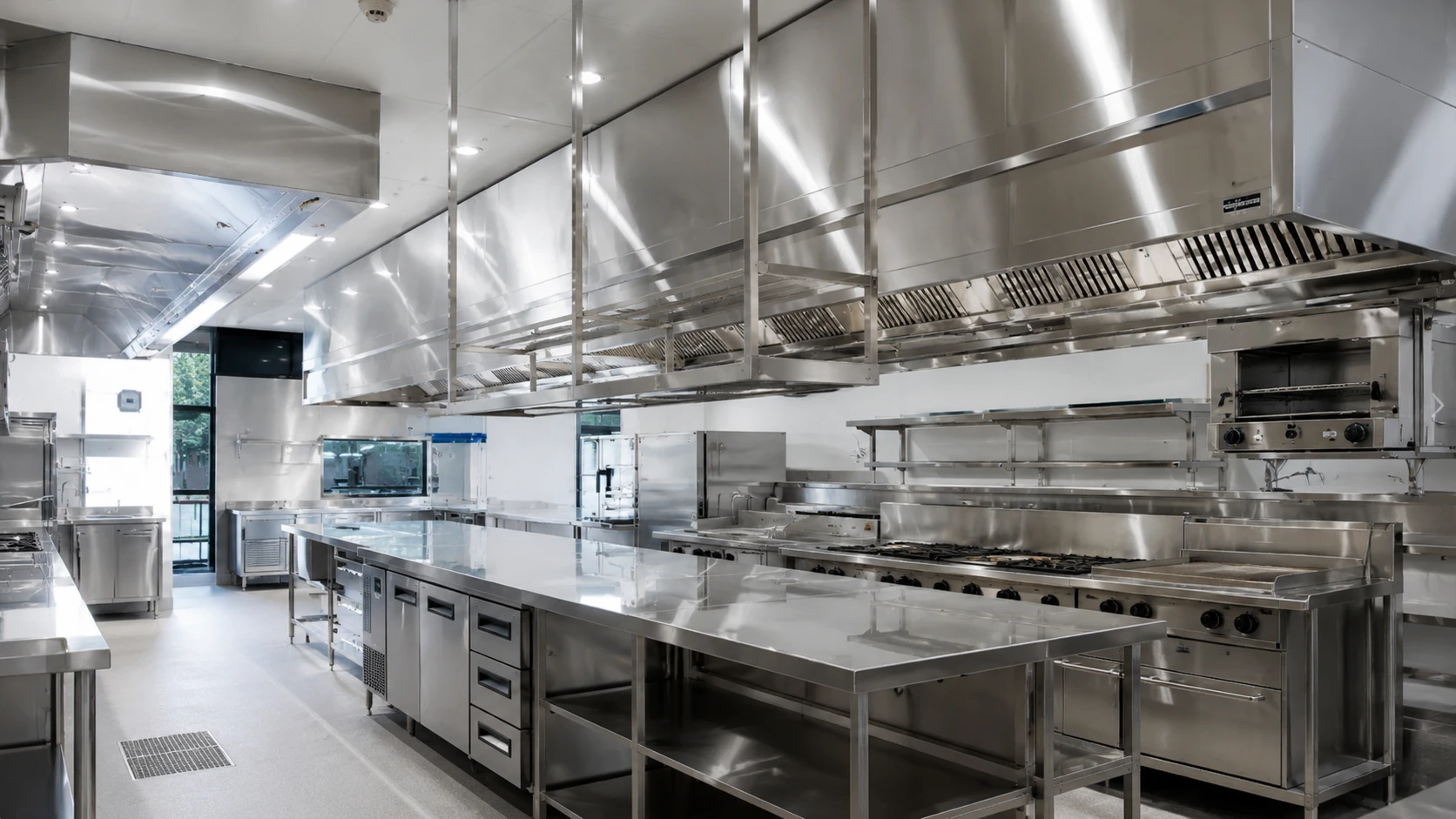
AS4674-2004 requires all food contact surfaces in a commercial kitchen to be smooth, impervious, and easily cleanable. In practice this means stainless steel benching throughout the food preparation and cooking areas of the kitchen.
Commercial stainless steel benching is custom fabricated to the specific dimensions of the kitchen. It is not off-the-shelf furniture. The bench configuration, the under-bench storage, the sink integration, the splashback height, and the connection to the exhaust canopy structure are all part of the custom fabrication scope.
The wall and floor surfaces behind cooking equipment must also meet AS4674 requirements. Ceramic tiles with flush grout joints or stainless steel wall cladding are the standard approaches. Grout joints in tile surfaces behind cooking equipment must be sealed and maintained to prevent grease accumulation that creates both a hygiene and a fire risk.
Cool Rooms and Refrigerated Storage
Most full-service commercial kitchens in Sydney include a cool room for perishable food storage. A cool room is a purpose-built refrigerated enclosure constructed as part of the kitchen fitout.
Key cool room cost variables:
The size of the cool room determines the refrigeration load and the refrigeration equipment specification. A larger cool room requires a more powerful refrigeration unit and more extensive installation.
A cool room with a freezer section requires separate refrigeration systems for each temperature zone with appropriate insulation between zones.
The location of the cool room within the kitchen affects the ductwork and piping runs for the refrigeration equipment. A cool room positioned against an external wall is typically cheaper to connect than one in the middle of the kitchen floor plan.
Under AS 4674 cool rooms must be constructed with appropriate floor drainage and the floor surface must be cleanable and slip resistant. The doorway must have appropriate strip curtains or self-closing insulated doors to maintain temperature when the door is opened.
DA and Food Premises Registration
A Development Application is required from the local council before construction of a commercial kitchen or food premises can begin in NSW. The DA application must include drawings that demonstrate compliance with AS 4674 and the council's food premises construction requirements.
Sydney Water trade waste approval must be obtained before the kitchen can discharge to sewer. This application is separate from the DA and must include the grease trap specification and the kitchen drainage design.
Food premises registration under the Food Act 2003 is required before the kitchen can operate. The registration application triggers a council inspection of the completed fitout to confirm it meets AS 4674 requirements. If the inspection identifies non-compliance the kitchen cannot open until the deficiencies are rectified.
Broad Indicative Cost Ranges for Sydney Commercial Kitchen Fitouts in 2026
The following ranges cover construction, compliance, stainless steel benching, exhaust system, grease trap, fire suppression, and project management. They do not include commercial kitchen equipment, cool room refrigeration equipment, or food premises registration fees.
Small Cafe Kitchen or Minimal Food Preparation Kitchen up to 40sqm
A small kitchen with basic cooking equipment, a compact exhaust system, grease trap connection, and standard stainless steel preparation surfaces.
Broad indicative construction range: $50,000 to $200,000
What moves this number higher: full cooking line with fryers and grills, cool room installation, complex ductwork routing in a multi-level building, heritage building constraints, tight construction programme.
Standard Restaurant or Cafe Kitchen 40sqm to 80sqm
A full-service kitchen with a complete cooking line, full exhaust canopy system, grease trap, wet chemical suppression, cool room, and comprehensive stainless steel fitout.
Broad indicative construction range: $200,000 to $500,000
What moves this number higher: long ductwork runs in a multi-level building, large cool room or separate freezer room, dishwasher room with commercial drainage, preparation kitchen separate from main cooking line, premium tile specification throughout.
Large Restaurant Kitchen or Hotel Kitchen 80sqm and above
A high-volume kitchen with multiple cooking stations, large exhaust systems, extensive cool room and freezer infrastructure, and comprehensive trade waste compliance.
Broad indicative construction range: $500,000 to $750,000 and above
Commissary or production kitchens serving multiple venues can exceed $750,000 for the construction side before equipment is procured.
Disclaimer: Every cost figure in this guide is a broad indicative range only. It is not a quote, not an estimate, and not a representation of what your fitout will cost. Commercial kitchen fitout costs in Sydney are determined by your specific kitchen type, the cooking equipment being installed, the exhaust system requirements, the grease trap configuration, the ductwork routing, the cool room scope, the cost of materials and labour at the time your project is priced, market conditions, supply chain, and the level of finish and detail you require. Two kitchens with the same floor area can produce vastly different construction costs depending on these variables. Nothing in this guide should be relied upon for budgeting, financial planning, lending, or business case purposes. The only way to get a reliable cost assessment for your specific project is to engage an experienced commercial kitchen fitout specialist who has physically inspected your site.
Why Compliance Mapping Must Happen Before Construction Starts
The four compliance frameworks that govern a Sydney commercial kitchen fitout (AS4674, AS 1668.2, AS/NZS 3500.2, and AS 1851) are interconnected. A decision made to satisfy one standard can create an obligation under another.
The grease trap specification affects the drainage design which affects the floor construction which affects AS 4674 compliance. The exhaust canopy specification affects the make-up air system which affects the HVAC design which affects the mechanical compliance. The wet chemical suppression system specification affects the canopy design which affects the exhaust system.
Getting any one of these wrong after construction starts is expensive to fix. Retrofitting a larger grease trap after the floor slab is complete requires breaking up and reinstating the concrete. Modifying an exhaust system after installation to meet AS 1668.2 airflow requirements means dismantling ductwork. Changing the suppression system nozzle configuration after the canopy is installed means reopening the canopy and replumbing the suppression lines.
All of this is avoidable when the compliance framework is mapped correctly before design is finalised and before construction starts.
Planning a commercial kitchen fitout in Sydney? Building Project Solutions has delivered hospitality fitouts across Sydney for 35 years including commercial kitchens of every scale and type. Book a strategy session with Stephen before you commit to a site or a design.
How to Protect Your Budget on a Sydney Commercial Kitchen Fitout
Map the exhaust ductwork routing before you commit to the site. The routing of exhaust ductwork from the canopy to the building exterior is one of the biggest variables in kitchen fitout cost. A building where ductwork must travel through multiple floors and fire-rated penetrations costs significantly more than one with direct roof access. Understand this before you sign a lease.
Specify the grease trap location and size before the slab is poured. The grease trap connection pipework is buried below the floor slab. Changes to the grease trap location or size after the slab is poured require breaking up and reinstating concrete. Get the specification right at design stage.
Coordinate equipment procurement with construction programming. Commercial kitchen equipment has lead times that can extend 8 to 16 weeks for imported or specialist items. The equipment specification must be finalised before the kitchen is designed so the exhaust canopy, the under-bench configuration, and the power and gas supply are built to suit the actual equipment being installed.
Obtain DA and Sydney Water trade waste approval before construction starts. Both approvals are required before the kitchen can operate. Both have lead times. The DA assessment for a food premises includes a review of the AS 4674 compliance of the design. Starting construction before DA approval is granted is a serious risk.
Speak with someone who has delivered commercial kitchen fitouts many times. The intersection of AS 4674, AS 1668.2, AS/NZS 3500.2, and AS 1851 requires a builder who understands how these standards interact and what councils look for in a food premises inspection. Stephen Spagnol has delivered commercial kitchen fitouts across Sydney for 35 years. Contact BPS today to discuss your project before you commit to anything.
Get a real assessment for your commercial kitchen project. Stephen Spagnol has 35 years of Sydney fitout experience including commercial kitchens for restaurants, cafes, bars, hotels, and catering operations. Contact BPS today for an honest conversation about your project before you commit to anything. No obligation. No pressure. Just clarity.
Frequently Asked Questions
How much does a commercial kitchen fitout cost in Sydney?
As a broad indicative guide only, commercial kitchen fitout costs in Sydney in 2026 range from approximately $50,000 to $200,000 for a small cafe kitchen through to $750,000 or more for a large restaurant or hotel kitchen. These figures cover construction and compliance only and do not include commercial kitchen equipment which typically represents 40 to 60 percent of the total project budget and is procured separately. Every project is different and costs vary significantly depending on kitchen type, cooking equipment, exhaust system complexity, grease trap configuration, and market conditions at the time your project is priced. These figures are not quotes or estimates and should not be used for budgeting without a site inspection from an experienced specialist.
What compliance standards apply to a commercial kitchen fitout in Sydney?
Commercial kitchen fitouts in Sydney must comply with AS4674-2004 which governs the design, construction, and fitout of food premises. AS 1668.2 governs mechanical ventilation and exhaust systems. AS/NZS 3500.2 requires grease traps on all commercial kitchen drains. AS 1851 governs fire safety systems including the wet chemical suppression system above cooking equipment and the annual exhaust cleaning requirements. A Development Application is required from the local council and Sydney Water trade waste approval is required before the kitchen can discharge to sewer. Food premises registration under the Food Act 2003 is required before the kitchen can operate.
How long does a commercial kitchen fitout take in Sydney?
As a general guide, a standard commercial kitchen fitout in Sydney takes 8 to 14 weeks from construction start to operation depending on scope and complexity. This does not include the DA approval phase which adds time before construction can start, or the Sydney Water trade waste approval process. Commercial kitchen equipment with long lead times needs to be ordered well in advance of the construction start date. Every project runs to its own programme.
Do I need DA approval for a commercial kitchen fitout in Sydney?
Yes. A Development Application is required from the local council before construction of a commercial kitchen or food premises can begin in NSW. The DA application must include drawings demonstrating compliance with AS 4674 and the council's food premises construction requirements. Sydney Water trade waste approval is a separate process also required before the kitchen can discharge to sewer. Food premises registration triggers a council inspection of the completed fitout before the kitchen can operate.
What is the biggest cost driver in a commercial kitchen fitout?
The exhaust canopy and ventilation system is consistently the most underestimated cost driver in a commercial kitchen fitout. The ductwork routing from the canopy to the building exterior is the single biggest variable: a kitchen in a multi-level building where ductwork must travel through multiple floors and fire-rated penetrations costs significantly more than one with direct roof access. Equipment represents 40 to 60 percent of the total project budget but is procured separately. The grease trap installation including external tank, connecting pipework, and Sydney Water trade waste approval is the next most commonly underestimated line item.
Ready to discuss your project?
Our team has 35 years of experience delivering Hospitality Fitouts across Sydney.
Get in Touch